

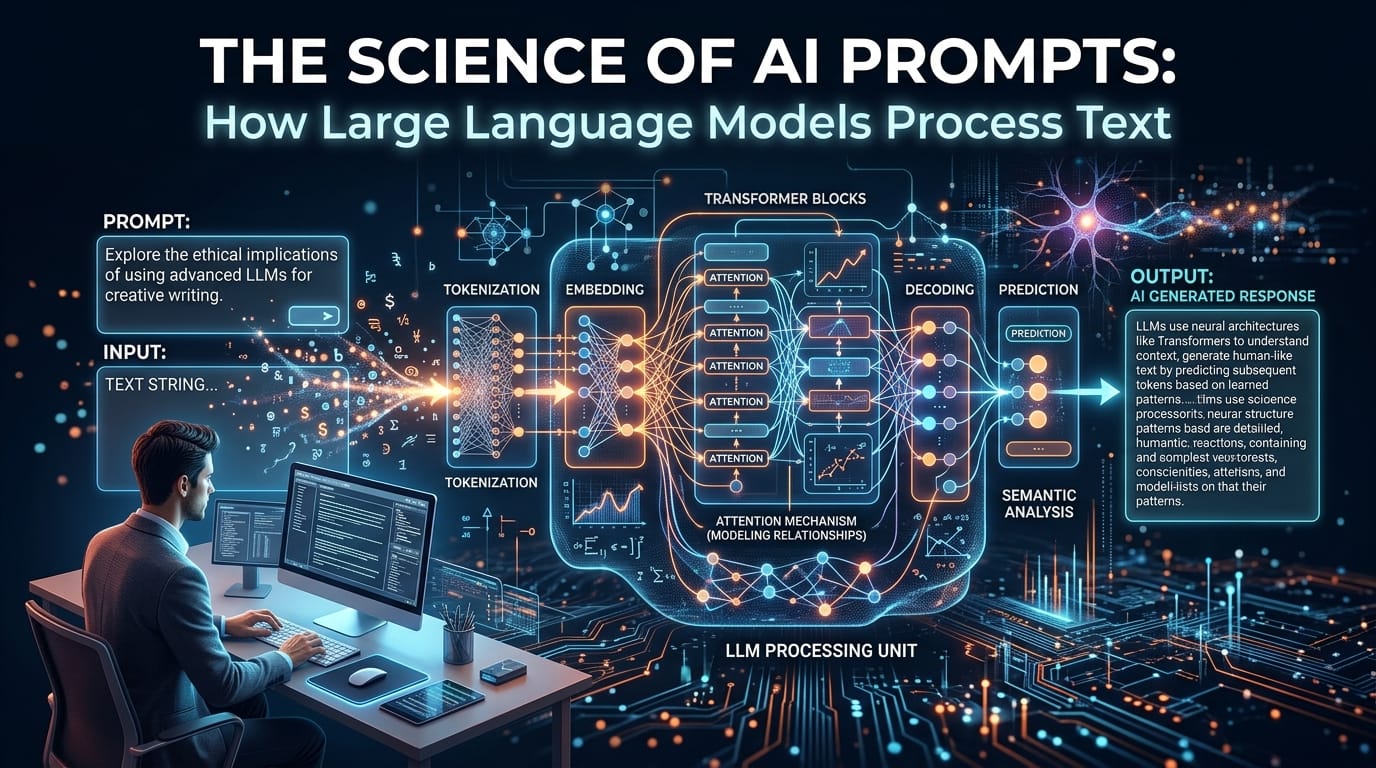
Artificial intelligence helps in reading and writing fields, from writing articles and creating software to answering questions and analyzing information. AI systems can perform increasingly complex language-based tasks. At the center of these interactions is something that looks simple but plays an important role: the AI prompt.
A prompt is the text, instruction, question, or information provided to an artificial intelligence system. Although entering a prompt may take only a few seconds, sophisticated computational processes take place behind the scenes before an AI model produces its response.
Understanding the science of AI prompts provides valuable insight into how modern large language models (LLMs) process human language, interpret context, identify relationships between words, and generate responses.
This guide explores the science of AI prompts, including tokenization, embeddings, Transformer architecture, attention mechanisms, context windows, probability, and prompt engineering.
What Is the Science of AI Prompts?
The science of AI prompts is the study of how instructions and natural-language input interact with artificial intelligence models to produce an output.
An AI prompt can be extremely simple:
“What is artificial intelligence?”
Or it can contain detailed instructions:
Both are prompts, but the second provides significantly more context and constraints.
Large language models do not interpret prompts exactly as humans do. Instead, they convert language into numerical representations, analyze patterns and relationships within the input, and calculate likely continuations based on patterns learned during training.
Therefore, the science of AI prompts combines principles from natural language processing, machine learning, statistics, and computational linguistics.
How Large Language Models Process Text
To understand how Science AI prompts work, it is useful to look at the basic pipeline through which an LLM processes text.
Basic science of AI prompts
A simplified process looks like this:
- The prompt enters the AI system.
- The text is divided into tokens.
- Tokens are converted into numerical representations.
- The model analyzes relationships between tokens.
- Context and attention mechanisms help determine relevance.
- The model predicts possible next tokens.
- Selected tokens are generated sequentially.
- The resulting tokens are converted back into readable text.
This process happens extremely quickly, which makes the interaction appear almost instantaneous.
What Is Tokenization?
Tokenization is one of the first stages in the science of AI prompts.
Large language models generally do not process an entire paragraph as a single unit. Instead, text is broken into smaller pieces called tokens.
A token may represent:
- A complete word
- Part of a word
- A punctuation mark
- A number
- A frequently occurring character sequence
For example, a technical term that is uncommon may be divided into multiple tokens, while a frequently used word may be represented by a single token.
Tokenization allows an AI model to convert human language into a form that can be processed mathematically.
It also explains why prompt length matters. AI models have a defined context capacity, and the number of tokens in a conversation can affect how much information the model can consider at once.
How AI Converts Text Into Numerical Representations
Once text has been tokenized, the tokens are represented numerically.
This is where embeddings become important.
An embedding is a mathematical representation of a token or concept. Instead of treating a word merely as a sequence of letters, an AI model represents it using numerical values that capture relationships learned from training data.
For example, words related to technology may develop relationships within the model’s internal representation. Terms such as:
- artificial intelligence
- machine learning
- neural networks
- automation
- language models
can have meaningful relationships because they frequently occur in related contexts.
Embeddings allow the model to perform mathematical operations that help it process language patterns.
The Role of Transformer Architecture
The Transformer architecture is one of the most important developments behind modern large language models.
Transformers allow AI systems to process relationships between different parts of a sequence rather than simply reading each word independently.
Transformer-based architectures use mechanisms that help identify these relationships.
This is particularly important for longer prompts where information appearing at different positions can influence the meaning of the overall request.
Understanding the Attention Mechanism
The attention mechanism is a central concept in the science of AI prompts.
Attention allows a language model to determine which parts of the input are relevant when processing a particular token.
Attention mechanisms help the model assign importance to relationships within the input.
This does not mean that the AI “understands” text in exactly the same way humans do. Rather, it calculates relationships among representations based on patterns learned during training.
Why Context Is Important in AI Prompts
The second prompt provides substantially more information about the intended task.
Useful context can include:
- Target audience
- Subject
- Purpose
- Tone
- Length
- Formatting
- Examples
- Restrictions
- Desired outcome
This is one of the most practical lessons from the science of AI prompts: AI models perform tasks within the context provided to them.
How AI Predicts the Next Token
Large language models generate text by predicting what token should come next.
Suppose a model receives:
“The largest planet in our solar system is…”
Based on patterns learned during training, the model assigns a very high probability to “Jupiter.”
For a creative request, however, there may be many plausible options.
For example:
“Write a story about a scientist who discovers…”
Could lead to many possible continuations.
The model evaluates possible tokens and generates them sequentially. The output is therefore produced dynamically rather than simply being copied from a stored answer.
This probability-based generation is an essential component of the science of AI prompts.
What Is Prompt Engineering?
Prompt engineering is the practice of designing and refining prompts to communicate tasks effectively to AI models.
Good prompt engineering does not require complicated language. Instead, it focuses on clarity, context, and structure.
A useful prompt can contain five major elements:
1. Role
Specify a useful perspective.
Example
“Act as an experienced SEO content writer.”
2. Task
Explain exactly what needs to be done.
Example
“Write an SEO-friendly blog article.”
3. Context
Provide information about the subject and audience.
4. Constraints
Specify requirements such as length, tone, or formatting.
5. Output Format
Describe the desired structure.
Combining these elements gives the AI a clearer objective.
Why Specific Prompts Often Work Better
Specificity can reduce ambiguity.
For example, the prompt:
“Make this article better.”
Does not establish what “better” means.
A more precise instruction could be:
“Rewrite this article in a professional and easy-to-read style. Improve sentence structure, remove repetition, preserve the original meaning, and organize the content using descriptive H2 headings.”
The second prompt provides measurable objectives and constraints.
This demonstrates how the science of AI prompts can be applied to everyday AI interactions.
Common Mistakes When Writing AI Prompts
Even experienced AI users can make prompting mistakes.
Vague Instructions
A prompt with little information may produce a response that does not match the user’s expectations.
Conflicting Requirements
Instructions that contradict one another can make it difficult for the model to determine the desired output.
Too Much Irrelevant Information
Adding unnecessary details can make a prompt less focused.
Unclear Output Requirements
If you need a table, bullet list, article, summary, or JSON structure, specifying the format can make the desired result clearer.
Assuming AI Is Always Correct
Large language models can generate inaccurate information. AI output should be reviewed and fact-checked when accuracy is important.
Science AI Prompts and Context Windows
Another important concept is the context window.
A context window represents the amount of information an AI model can process as part of a particular interaction. Modern models can support very large contexts, but simply adding more information does not automatically produce better results.
For lengthy tasks, users can improve clarity by organizing information into sections and explicitly explaining what the model should focus on.
For example:
Objective → Background → Source Information → Instructions → Output Format
This structure makes complex prompts easier to interpret.
Practical Applications of the Science of AI Prompts
Content Marketing
Marketers can use detailed prompts to generate article outlines, social media ideas, product descriptions, and campaign concepts.
Software Development
Developers can describe programming requirements, debugging problems, and desired functionality to AI coding assistants.
Education
Students and teachers can use prompts to request explanations, practice questions, summaries, and learning exercises.
Business
Companies can use AI prompts for customer-service drafts, market research assistance, sales messaging, internal documentation, and data analysis.
Research
Researchers can use structured prompts to organize information, summarize documents, generate research questions, and compare concepts.
Related Guides on UrgeSales
- What Is Claude AI? Features, Uses and Benefits
- What Is DeepSeek AI? Features, Uses & Benefits
- What Is Kimi AI? Features, Uses and Benefits
- How Artificial Intelligence Helps Boost Sales: 8 AI Tools for Sales Teams
You Can Also Read :
How Clay AI Helps Increase Sales; AI-Powered Sales Prospecting
You Can Also Visit Official Link
[…] HubSpot AI Helps Generate More Sales 10 Ways to get more Sales The Science of AI Prompts: How Large Language Models Process Text How Apollo.io Helps Boost Sales Saleshandy ; How It Boosts Sales, Generates Leads & […]