

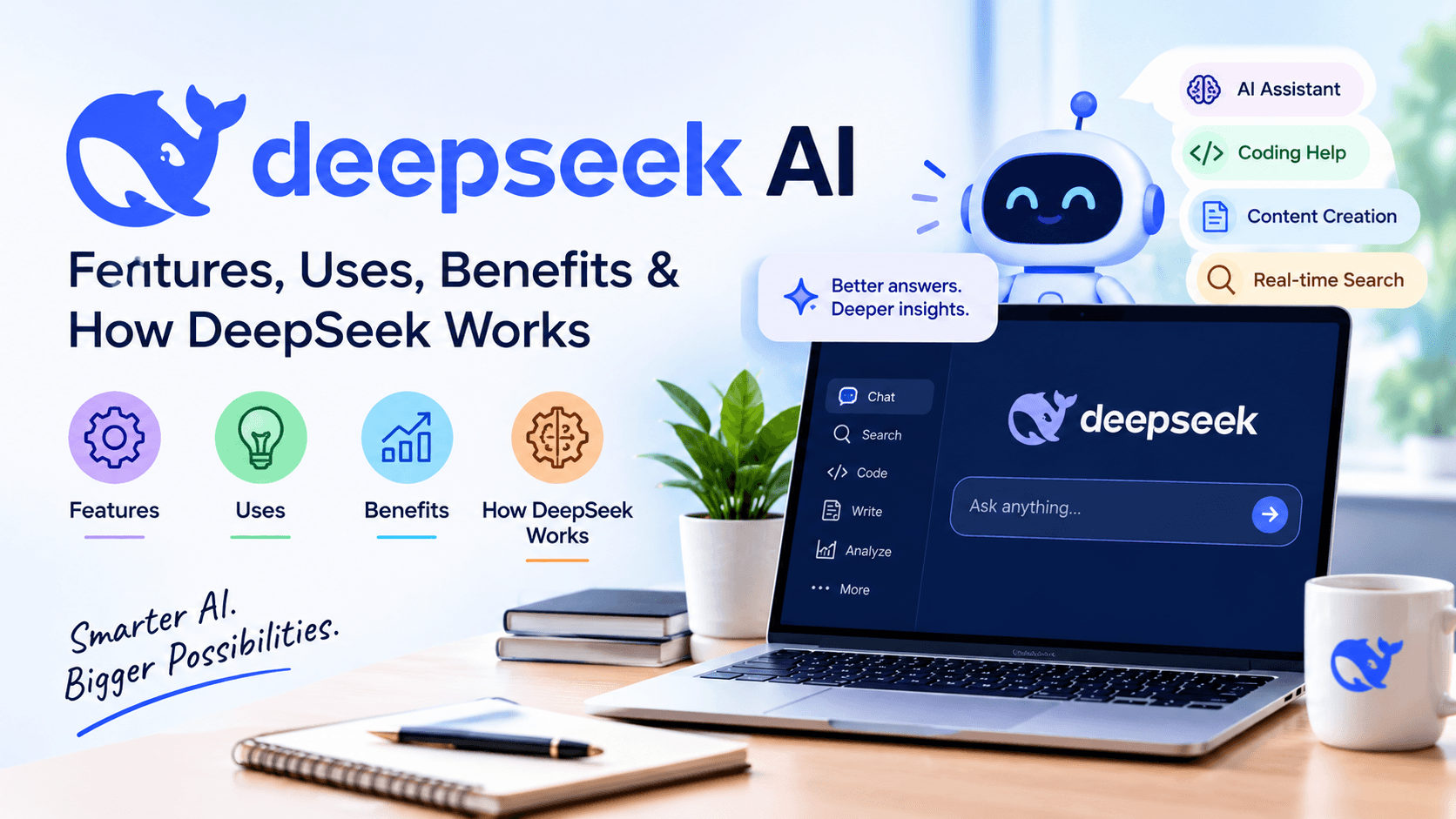
DeepSeek AI
Features, Uses, Benefits & How DeepSeek Works
Artificial intelligence has become one of the fastest-growing areas of technology, with new AI models and assistants changing how people work, learn, create content, and develop software. Among the AI platforms gaining significant attention, DeepSeek has become a notable name in the generative AI industry.
DeepSeek AI is known for its advanced language models, reasoning capabilities, coding performance, and open-model approach. The platform has attracted developers, businesses, researchers, students, and everyday users who want to explore powerful AI capabilities.
What Is DeepSeek AI?
DeepSeek AI is an artificial intelligence company and AI model ecosystem known for developing large language models and AI assistants.
DeepSeek models can process natural-language instructions and generate responses for tasks such as writing, programming, mathematical problem-solving, analysis, research, and reasoning.
One of the reasons DeepSeek attracted attention was its emphasis on highly capable models with openly released model weights and technical research. DeepSeek-V3, released in December 2024, was introduced as a large mixture-of-experts model, while DeepSeek-R1, released in January 2025, focused heavily on reasoning.
Who Created DeepSeek AI?
DeepSeek was developed by a Chinese AI research company known as DeepSeek.
The company has focused on developing large language models and making significant parts of its model technology available to the broader AI community.
This approach has helped DeepSeek attract attention from developers and researchers interested in experimenting with AI models outside traditional closed-platform ecosystems.
How Does DeepSeek AI Work?
DeepSeek uses large language models trained to understand and generate human-like text.
When you enter a prompt, the model processes the instructions and context and generates a response based on patterns learned during training.
Different DeepSeek models are designed for different types of workloads. Some emphasize fast general-purpose responses, while reasoning-oriented models are designed to spend more computational effort working through complex problems.
For example, DeepSeek-V3.1 introduced separate thinking and non-thinking modes, allowing users to choose between faster responses and deeper reasoning. DeepSeek also expanded capabilities around tool use and multi-step agent tasks.
DeepSeek AI Models & Versions
DeepSeek has released several important models as its AI ecosystem has developed.
DeepSeek-V3
DeepSeek-V3 was introduced in December 2024 and became one of the company’s major general-purpose models.
According to DeepSeek, V3 uses a mixture-of-experts architecture with 671 billion total parameters and 37 billion activated parameters. The model was trained on 14.8 trillion tokens.
DeepSeek positioned V3 as a powerful model for general AI tasks, including coding, mathematics, knowledge-based questions, and long-form text generation.
DeepSeek-R1
DeepSeek-R1 became particularly well known for its reasoning capabilities.
Released in January 2025, DeepSeek said R1 was designed to improve performance on tasks involving mathematics, coding, and reasoning. The company also released the model and technical report under an MIT license.
DeepSeek-R1 helped bring increased attention to reasoning-focused AI models and became an important part of the company’s model lineup.
DeepSeek-V3.1
DeepSeek-V3.1 represented another step toward more agent-oriented AI.
The model introduced hybrid inference with thinking and non-thinking modes and improvements in tool use and multi-step agent tasks. DeepSeek also reported 128K context support for both its thinking and non-thinking API modes.
DeepSeek-V3.2
DeepSeek later introduced DeepSeek-V3.2, describing it as a reasoning-first model designed with AI agents in mind.
According to DeepSeek, V3.2 integrates reasoning directly with tool use and supports tool use in both thinking and non-thinking modes. A specialized V3.2-Speciale model was also introduced for more demanding reasoning workloads.
Key Features of DeepSeek AI
- Advanced Reasoning
One of the strongest areas associated with DeepSeek AI reasoning.
Reasoning-oriented DeepSeek models are designed to work through complex problems rather than simply generating an immediate response.
This can be useful for mathematics, programming, logical analysis, research, and multi-step problem-solving.
- Coding Assistance
DeepSeek coding is another major use case.
Developers can use DeepSeek AI to:
- Generate code
- Explain programming concepts
- Debug errors
- Review code
- Refactor existing code
- Create scripts
- Build prototypes
- Generate technical documentation
DeepSeek’s focus on coding and reasoning has made it an interesting option for software developers and technical teams.
- AI Writing
DeepSeek can also assist with content creation.
Users can ask DeepSeek to create:
- Blog outlines
- Articles
- Emails
- Product descriptions
- Social media content
- Reports
- Summaries
- Marketing ideas
As with other generative AI tools, human review is important when accuracy, originality, or brand consistency matters.
- Mathematics and Problem Solving
DeepSeek’s reasoning-focused models can be useful for mathematical and logical tasks.
Students, developers, researchers, and professionals can use AI to work through complex problems and ask for explanations of the reasoning behind an answer.
However, users should independently verify important calculations and conclusions.
- Large Context Windows
Some DeepSeek models support long context windows, allowing the system to process substantial amounts of information within a conversation or application.
DeepSeek-V3.1, for example, was announced with 128K context support for its API modes.
This can be particularly useful when working with long documents, technical material, codebases, or complex instructions.
- Tool Use and AI Agents
Modern DeepSeek development is increasingly focused on AI agents.
DeepSeek-V3.1 introduced improvements in tool use and multi-step agent tasks, while V3.2 integrated reasoning with tool use.
This direction could allow AI systems to do more than answer questions by helping users complete multi-step workflows.
How to Use DeepSeek AI
Using DeepSeek AI generally starts with accessing the available DeepSeek interface or integrating a DeepSeek model through its API.
The quality of the output depends heavily on the prompt.
Instead of asking:
“Write about digital marketing.”
Try providing more specific instructions:
“Create a 1,500-word beginner-friendly article about digital marketing for small businesses. Use SEO-friendly H2 headings, practical examples, and an FAQ section.”
A detailed prompt gives DeepSeek AI more information about the desired audience, format, tone, and objective.
For technical tasks, you can also provide code, error messages, requirements, and expected results.
DeepSeek AI for Businesses
Businesses can use DeepSeek AI for a variety of knowledge-based tasks.
Marketing teams can use AI for content planning and drafting. Developers can use DeepSeek for coding and technical workflows. Research teams can use AI to summarize and analyze information.
DeepSeek’s API can also allow developers to integrate models into their own applications and workflows.
For organizations considering DeepSeek, however, technical performance should not be the only consideration. Businesses should also evaluate privacy, security, compliance, data handling, infrastructure, licensing, reliability, and cost.
DeepSeek AI for Students
Students can use DeepSeek as a learning assistant for explanations, brainstorming, coding practice, mathematics, and summarization.
For example, a student can ask DeepSeek to explain a difficult programming concept in simple language and then provide examples and practice questions.
However, students should use AI as a learning aid rather than simply copying generated answers. Understanding the underlying concepts remains essential.
DeepSeek AI vs ChatGPT
DeepSeek AI vs ChatGPT is one of the most common comparisons in the AI market.
Both platforms provide AI assistance for writing, coding, reasoning, research, and productivity. However, they come from different companies and have different product ecosystems.
DeepSeek has gained attention for its reasoning-focused models, open-model releases, and emphasis on coding and technical capabilities. ChatGPT, meanwhile, offers a broader product ecosystem with its own range of models and features.
The better option depends on what you need.
When comparing DeepSeek with ChatGPT, consider:
- Reasoning performance
- Coding capabilities
- Writing quality
- Context length
- API availability
- Tool support
- Privacy requirements
- Pricing
- Business integrations
- Ease of use
AI models change frequently, so comparisons should always be based on current versions rather than older benchmark results.
Benefits of Using DeepSeek AI
DeepSeek offers several potential advantages for AI users.
Strong Reasoning Capabilities
Reasoning-focused DeepSeek models are designed for complex mathematical, coding, and logical tasks.
Coding Support
Developers can use DeepSeek for code generation, debugging, explanations, and technical workflows.
Open Model Ecosystem
DeepSeek has released model weights and technical materials for several models, helping developers and researchers experiment with the technology. DeepSeek-R1, for example, was released under the MIT license.
Flexible AI Applications
DeepSeek can support writing, research, programming, mathematics, analysis, and increasingly complex agent workflows.
You Can Visit :
You Can Also Read :
B2B Lead Generation Strategies for Small Business
[…] Uses and Benefits What Is Pipedrive? 8 Features, Benefits, Pricing & How It Works What is DeepSeek AI? Features and Uses What is Claude AI its Features, Uses and […]