
Introduction:
Agentic AI vs. Traditional Sales Automation
Now days we have so many options and tools to boost sales get more profit and customers. As businesses adopt Artificial intelligence sales teams are moving farther rule based automation to become more intelligent and autonomous system.
As businesses increasingly adopt artificial intelligence, sales teams are moving beyond rule-based automation toward more intelligent, autonomous systems. Traditional sales automation has long helped organizations streamline repetitive tasks such as sending follow-up emails, updating customer records, and scheduling meetings. While these tools improve efficiency, they typically operate by following predefined rules and workflows, requiring human intervention whenever unexpected situations arise.
Agentic AI represents the next stage in sales technology.
Agentic AI can understand sales goals, sales analysis, customer interactions, decision making and perform actions independently. It acts like a digital sales assistant that can adapt to changing customer behavior, prioritize leads, personalize communication, and continuously optimize its approach based on new information. Rather than simply executing instructions, Agentic AI works proactively to achieve business objectives with minimal human supervision.
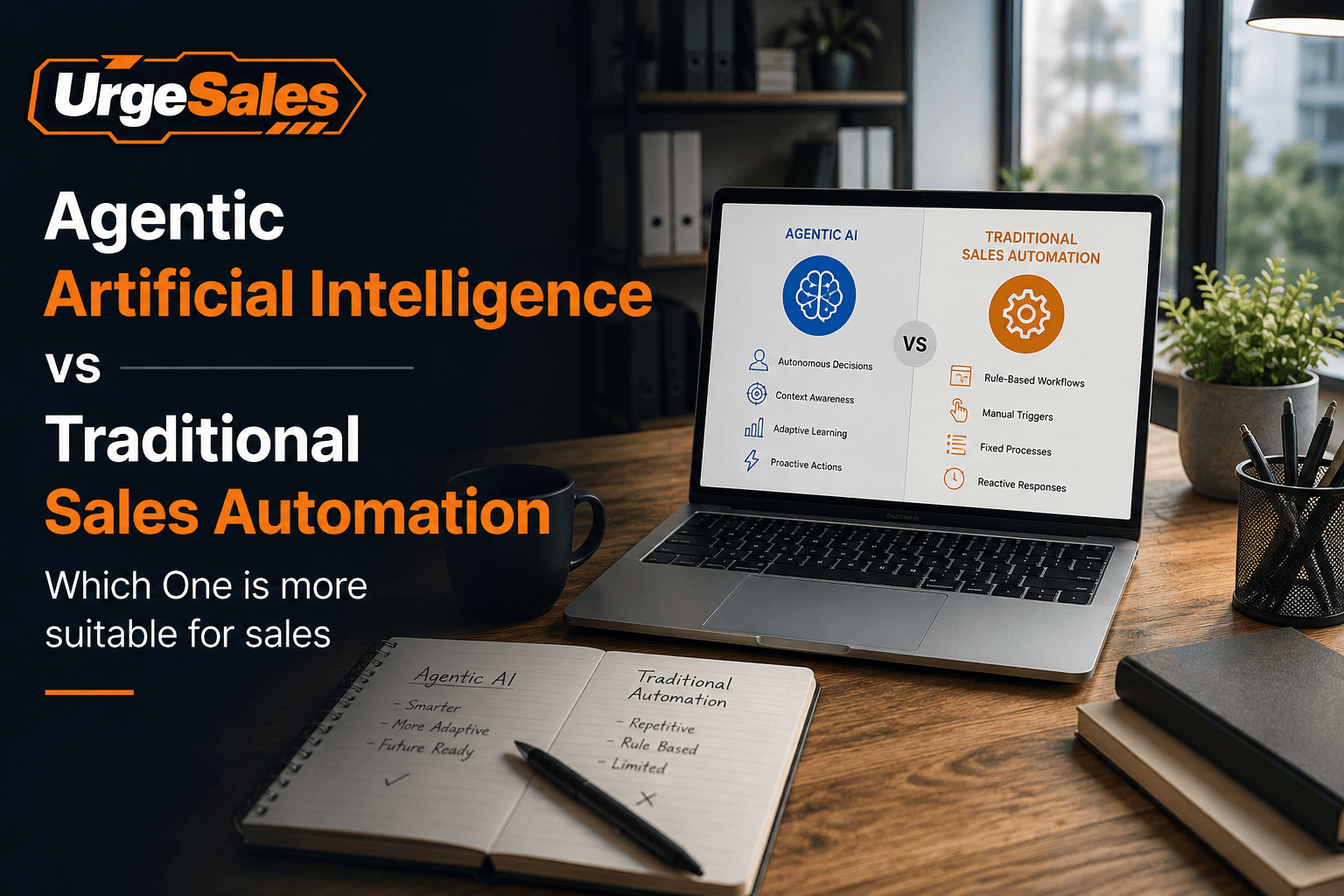
The key difference lies in intelligence and autonomy. Traditional sales automation is rule-driven, meaning it performs only the tasks it has been programmed to execute. In contrast, Agentic AI is goal-driven, capable of reasoning, learning from data, and making context-aware decisions. It enables sales organizations to provide response to customer needs in a much faster, improves sales profits, customer engagement and reduce manual effort. As companies seek more personalized and efficient sales processes, understanding the differences between Agentic AI and traditional sales automation is essential. This comparison highlights how autonomous AI agents are transforming modern sales by offering greater flexibility, adaptability, and decision-making capabilities than conventional automation systems
Agentic AI and traditional sales automation both improve sales operations, but they solve different problems. Traditional automation follows predefined rules, while agentic AI can make context-aware decisions, adapt to changing situations, and execute multi-step tasks with minimal human intervention.
What is Traditional Sales Automation?
Traditional sales automation uses software to automate repetitive sales activities based on predefined rules.
Examples
- Sending follow-up emails after 3 days
- Assigning leads based on location
- Scheduling meetings automatically
- Updating CRM after a form submission
- Sending reminders to sales representatives
Example Workflow
Customer fills contact form ↓CRM creates lead ↓Assign salesperson ↓Send welcome email ↓Wait 3 days ↓Send follow-up email
The software does exactly what has been programmed. If something unexpected happens, a person usually has to intervene. But if everything is happening according to their pre written program there is no need to involve anyone and tasks performed perfectly and its much time saving and convenient.
Benefits of Traditional Sales Automation
1. Saves Time
Automates repetitive administrative work. It performs tasks more efficiently and timely.
Example:
- CRM updates
- Email scheduling
- Lead assignment
2. Reduces Human Errors
When AI is involved it will send follow ups when needed. It will helps us to achieve goals efficiently. No forgotten follow-ups or missed reminders.
3. Standardized Process
Every customer receives the same sequence of emails and communications. No customer will feel that we are not treating equally. It will helps to make a reliable relation.
4. Cost Effective
Less expensive than advanced AI systems and easier to implement. With the help of this we can use human effort in any other more productive way
5. Easy Integration
Works well with CRM platforms like:
- Salesforce
- HubSpot
- Zoho
Limitations
- Cannot think independently
- No understanding of customer intent
- Cannot adjust strategies dynamically
- Generic customer communication
- Limited personalization
What is Agentic AI?
Agentic AI refers to AI systems that can reason, plan, make decisions, and execute complex tasks with minimal human intervention to achieve a defined objective.
Instead of simply following rules, the AI acts like a digital sales representative.
It can:
- Understand customer intent
- Prioritize leads
- Plan outreach
- Decide the best communication channel
- Generate personalized responses
- Learn from previous interactions
- Modify strategies based on outcomes
Example Workflow
Goal:
Convert qualified leads into customers
Receive new lead ↓Analyze company profile ↓Analyze LinkedIn activity ↓Research buying signals ↓Determine lead score ↓Generate personalized email ↓Schedule follow-up ↓Monitor replies ↓If no response: Try LinkedIn message ↓If interested: Book meeting automatically ↓Update CRM
No human needs to define every step in advance. The AI decides the next best action and performed it accurately and effectively in less time.
Benefits of Agentic Artificial Intelligence (AI)
1. Autonomous Decision Making
The AI evaluates multiple options and chooses the most appropriate action.
Example:
- Decide whether to email, call, or message a prospect based on prior engagement.
2. Hyper-Personalization
Each customer receives tailored communication.
Instead of:
“Hello Customer”
The AI may generate:
“Hi Sarah, I noticed your company recently expanded into healthcare. Based on that, here’s how our solution could reduce onboarding time.”
3. 24/7 Operation
The AI continuously:
- Responds to inquiries
- Follows up
- Researches prospects
- Updates CRM
- Books meetings
Without requiring breaks because human brain need break to focus efficiently.
4. Intelligent Lead Qualification
Instead of relying only on form data, the AI can evaluate:
- Company size
- Industry
- Website
- Technology stack
- Hiring trends
- Previous interactions
To prioritize the most promising leads.
5. Continuous Learning
The AI improves based on historical results.
For example:
- If prospects in healthcare respond better to case studies than demos, the AI can adapt future outreach accordingly.
6. Multi-Step Planning
Agentic AI can complete an entire workflow independently.
Example:
Research → Outreach → Follow-up → Meeting → CRM update → Proposal preparation.
7. Higher Sales Productivity
When AI is involved in sales it makes administrative work much easier and flexible then sales representatives have no need to spend time on these tasks. They can focus on closing deals and build strong and reliable relationships with customers.
8. Better Customer Experience
Customers receive faster, more relevant responses that reflect their context and previous interactions. When customer receive efficient responses there are much higher chances they will come back to us again and again and high chances they will tell others.
Real-World Example
Traditional Sales Automation
A prospect downloads an eBook.
The system:
- Sends Email 1
- Waits 3 days
- Sends Email 2
- Creates a CRM task
This happens regardless of whether the prospect actually engaged with the emails.
Agentic AI
A prospect downloads the same eBook.
The AI:
- Analyzes the prospect’s company and role.
- Determines they are a decision-maker.
- Checks whether they opened the email.
- Identifies they visited the pricing page twice.
- Sends a personalized follow-up focused on pricing.
- Schedules a meeting if the prospect expresses interest.
- Adjusts future outreach based on the prospect’s behavior.
Which Should You Choose?
- Choose Traditional Sales Automation if your goal is to automate repetitive, predictable tasks such as email sequences, CRM updates, reminders, and lead routing. It is simpler to deploy and more cost-effective for straightforward workflows.
- Choose Agentic AI if you want software that can reason, adapt, personalize interactions, and independently manage complex sales processes from lead qualification through follow-up and meeting scheduling.
In practice, many organizations combine both approaches: traditional automation handles structured, repetitive operations, while Agentic AI manages decision-making, personalization, and complex customer engagement. This hybrid model provides the efficiency of automation with the adaptability and intelligence of AI agents.