

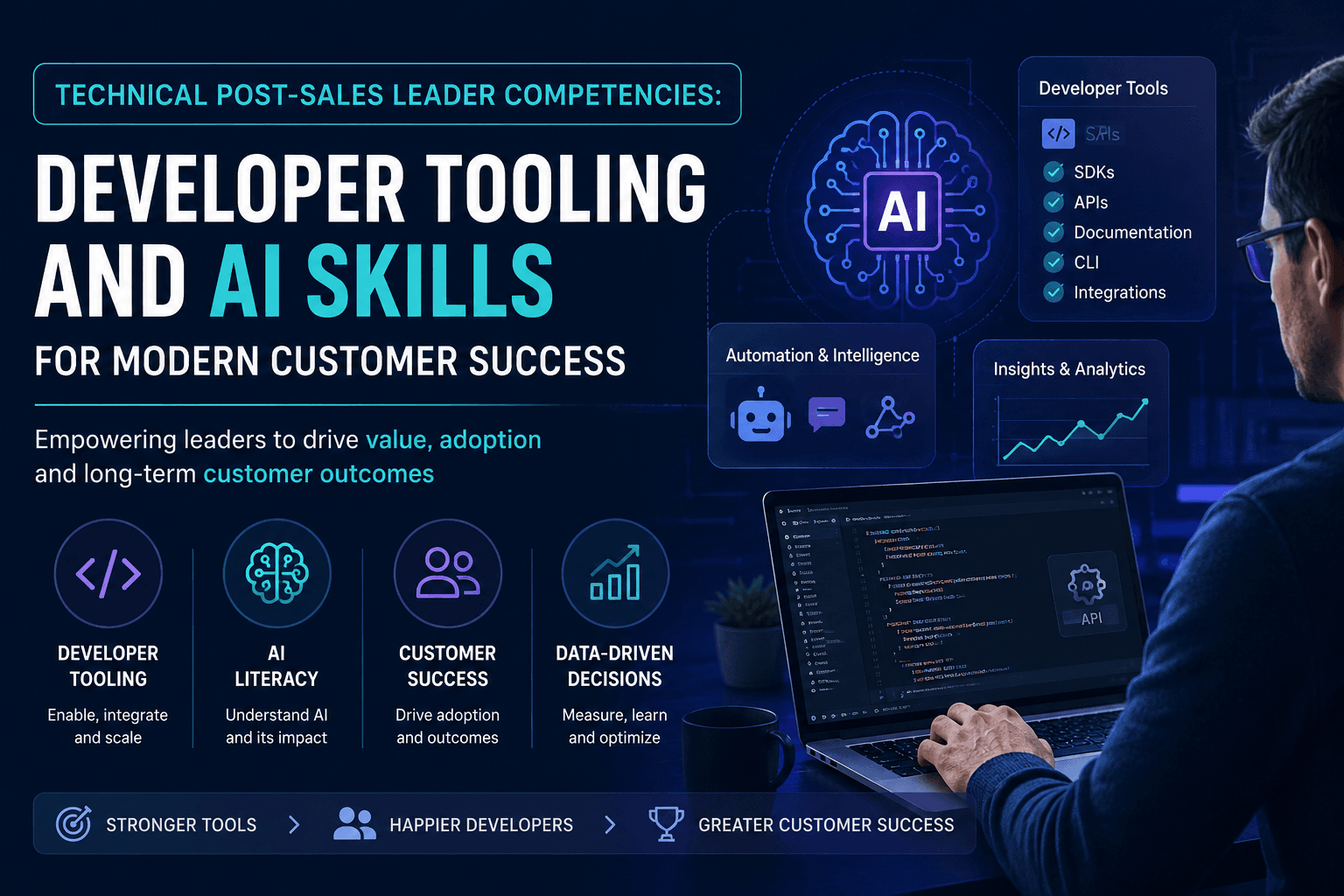
Technical Post-Sales Leader Competencies: Developer Tooling & AI Skills Developer Tooling and AI Skills for Modern Customer Success
Introduction
The role of a technical post-sales leader has changed significantly as SaaS, cloud computing, developer platforms, and artificial intelligence continue to reshape the technology industry. Modern customers do not simply expect a product to work after purchase. They want fast implementation, seamless integrations, measurable business outcomes, reliable technical support, and continuous innovation.
Strong technical post-sales leader competencies help organizations reduce implementation friction, improve developer experience, and accelerate customer adoption.
This shift has created demand for technical post-sales leaders who combine customer success, technical expertise, developer tooling, AI, leadership, and business strategy. For organizations selling APIs, SaaS platforms, cloud solutions, developer tools, and AI products, strong post-sales leadership can directly influence customer retention, expansion revenue, product adoption, and customer lifetime value.
Technical Post-Sales Leader Competencies
Unlike traditional customer success roles, this position requires a deeper understanding of software development, APIs, integrations, cloud infrastructure, data, cybersecurity, AI tools, and developer workflows.
A technical post-sales leader may oversee solutions architects, technical account managers, implementation specialists, customer success engineers, or professional services teams.
Their responsibilities commonly include:
- Driving successful customer onboarding
- Managing technical implementation
- Supporting API and platform integrations
- Improving product adoption
- Building technical relationships with developers
- Managing escalations
- Creating customer enablement programs
- Identifying expansion opportunities
- Using AI and automation to improve post-sales operations
The ultimate objective is simple: help customers achieve measurable outcomes from the technology they purchased.
Technical Post-Sales Leader Competencies: Core Skills
1. Technical Architecture and Product Expertise
Technical credibility is one of the most important competencies for a post-sales leader working with developer-focused products.
Leaders should understand how applications are designed, deployed, integrated, and maintained. They do not necessarily need to write production-level code every day, but they should be comfortable discussing software architecture and technical challenges with developers and engineering leaders.
Important areas include:
- APIs and SDKs
- REST and GraphQL
- Cloud platforms
- Databases
- Authentication and authorization
- Microservices
- Webhooks
- CI/CD pipelines
- Data integrations
- Security and compliance
Strong technical knowledge enables leaders to identify implementation risks early and provide practical guidance to customers.
2.Technical Post-Sales Leader Competencies for Developer Tooling
Developer tooling has become a critical component of modern technology businesses. Products such as APIs, SDKs, command-line interfaces, testing tools, observability platforms, and developer platforms require a different post-sales approach from conventional business software.
Technical post-sales leaders should understand the developer journey from documentation discovery to implementation and production deployment.
They should be able to evaluate:
- API documentation
- SDK usability
- Developer portals
- Authentication flows
- Sandbox environments
- Code samples
- API testing
- Error handling
- Debugging workflows
- Developer experience (DX)
A strong leader recognizes that developers are often highly influential in purchasing and expansion decisions. If the developer experience is complicated, customer adoption can suffer even when the underlying product is powerful.
-
AI Skills for Technical Post-Sales Leaders
AI literacy is now one of the most important technical post-sales leader competencies, particularly for organizations selling AI-powered software and developer platforms.
AI can improve customer onboarding, technical support, knowledge management, troubleshooting, and customer engagement. Leaders should understand how AI tools can be incorporated into post-sales workflows without compromising security or customer trust.
Relevant AI capabilities include:
- Generative AI
- AI copilots
- AI-powered customer support
- Automated technical documentation
- AI-based data analysis
- Workflow automation
For example, an AI assistant can help identify common implementation problems by analyzing support tickets, documentation, product usage, and previous solutions.
However, leaders must also understand AI limitations, including hallucinations, data privacy, security risks, model accuracy, and human oversight.
4. Customer Success and Technical Account Management
Technical knowledge alone does not make an effective post-sales leader. The ability to understand customer objectives and translate technical capabilities into business outcomes is equally important.
A technical post-sales leader should understand customer success metrics, including:
- Customer retention
- Net revenue retention (NRR)
- Product adoption
- Customer lifetime value (CLV)
- Expansion revenue
- Churn
- Time to value (TTV)
- Customer health scores
The leader must connect technical implementation with measurable business outcomes.
For example, instead of simply reporting that a customer successfully integrated an API, the post-sales team should demonstrate how that integration reduced manual work, increased conversion rates, improved operational efficiency, or generated additional revenue.
5. Cross-Functional Leadership
Technical customer problems often require collaboration between sales, customer success, engineering, product, support, security, and professional services.
A strong technical post-sales leader creates effective cross-functional processes.
For example, customer feedback should not remain inside a support ticket. Important patterns should reach product management and engineering teams so they can influence the product roadmap.
This requires strong skills in:
- Project management
- Escalation management
- Product feedback
- Internal communication
- Resource planning
- Prioritization
- Conflict resolution
6. Data-Driven Decision Making
Modern post-sales organizations generate significant amounts of customer data. Technical leaders should use this information to identify risks and opportunities.
Important data sources include:
- Product usage analytics
- API calls
- Feature adoption
- Support tickets
- Customer health scores
- Implementation timelines
- Renewal data
- Customer feedback
Analytics can help identify customers who are struggling with adoption or customers who may be ready for expansion.
AI-powered analytics can take this further by detecting patterns that may not be obvious through manual analysis.
7. Automation and Operational Efficiency
A major responsibility of modern post-sales leadership is scaling customer support without continuously increasing headcount.
Automation can help streamline repetitive activities such as:
- Customer onboarding
- Technical documentation
- Meeting summaries
- Follow-up tasks
- Support ticket classification
- Customer health monitoring
- Knowledge-base searches
Instead, automation should eliminate repetitive work and allow experts to spend more time solving complex customer problems.
8. Technical Problem-Solving
Customers frequently encounter challenges involving integrations, APIs, infrastructure, security, performance, or configuration.
A technical post-sales leader must be comfortable leading structured problem-solving processes.
A useful approach is:
- Define the problem.
- Identify the technical root cause.
- Determine customer impact.
- Evaluate possible solutions.
- Coordinate the required teams.
- Implement the solution.
- Measure the result.
- Document the learning.
This approach turns individual customer problems into reusable organizational knowledge.
9. Developer Experience and Documentation
Poor documentation can increase support volume, slow onboarding, and frustrate developers. Technical post-sales leaders should therefore collaborate with product and developer relations teams to improve documentation.
Effective developer documentation should include:
- Quick-start guides
- API references
- Tutorials
- Code examples
- Troubleshooting guides
- Authentication instructions
- Integration examples
- Frequently asked questions
A strong developer experience strategy can reduce time to first successful implementation and increase long-term product adoption.
10. Security, Privacy, and Compliance Awareness
AI and cloud technologies have increased the importance of security in post-sales conversations.
Technical post-sales leaders should understand fundamental concepts such as:
- Data protection
- Access control
- Encryption
- Authentication
- Authorization
- Compliance requirements
- Data residency
- AI security
- Enterprise risk management
Enterprise customers increasingly evaluate technology vendors based not only on functionality but also on their ability to protect sensitive information.
11. Strategic Leadership and Revenue Growth
The best technical post-sales leaders understand that customer success and revenue growth are connected.
When customers achieve strong outcomes, they are more likely to renew, expand usage, purchase additional products, and recommend the solution.
Technical post-sales teams can therefore contribute to:
- Renewal strategy
- Expansion opportunities
- Upselling
- Cross-selling
- Account growth
- Customer advocacy
The leader should work closely with sales and account management teams while maintaining customer trust and focusing on genuine business value.
The Future of Technical Post-Sales Leadership
The future of post-sales leadership will be increasingly influenced by AI agents, automation, developer platforms, cloud technology, and data analytics.
AI agents may eventually handle many routine technical support and onboarding tasks, while human leaders focus on complex architecture, strategic relationships, innovation, and business transformation.
At the same time, developer tooling will become increasingly important as organizations adopt APIs, AI platforms, cloud-native applications, and internal developer platforms.
This means future technical post-sales leaders will need a hybrid skill set combining:
Technical expertise + AI literacy + customer success + leadership + business strategy + developer experience.
Conclusion
Technical post-sales leader competencies now extend far beyond traditional customer support and implementation management.
The most successful leaders understand both sides of the equation: how technology works and how customers create value from it.
By developing strong competencies in AI, developer tools, technical architecture, customer success, data analytics, automation, communication, security, and strategic leadership, technical post-sales professionals can build scalable customer programs and drive long-term business growth.
As companies continue adopting AI-powered software, APIs, cloud platforms, and developer-centric products, demand for highly skilled technical post-sales leaders is likely to increase. Organizations that invest in this function will be better positioned to improve customer retention, accelerate product adoption, reduce time to value, and create sustainable expansion revenue
You can also visit
12 Best AI Sales Tools in 2026: AI Sales Software & Automation
UrgeSales AI sales agents
Want a steady flow of qualified B2B leads without manual prospecting?
UrgeSales AI agents find your ideal prospects, research each account, write personalized emails, follow up automatically and book meetings on your calendar.
Related Guides on UrgeSales
- Agentic AI vs Traditional Sales Automation: Which Is Better for Sales?
- 12 Best AI Sales Tools in 2026: AI Sales Software & Automation
- HubSpot AI vs Salesforce AI: Which Is Better for Sales Teams in 2026?
[…] AI vs Salesforce AI: Which Is Better for Sales Teams in 2026? Sales tools for small businesses Technical Post-Sales Leader Competencies: Developer Tooling & AI Skills How Many Emails Per Day Per Domain Cold Outreach? (Proven Guide) B2B Lead Generation […]