

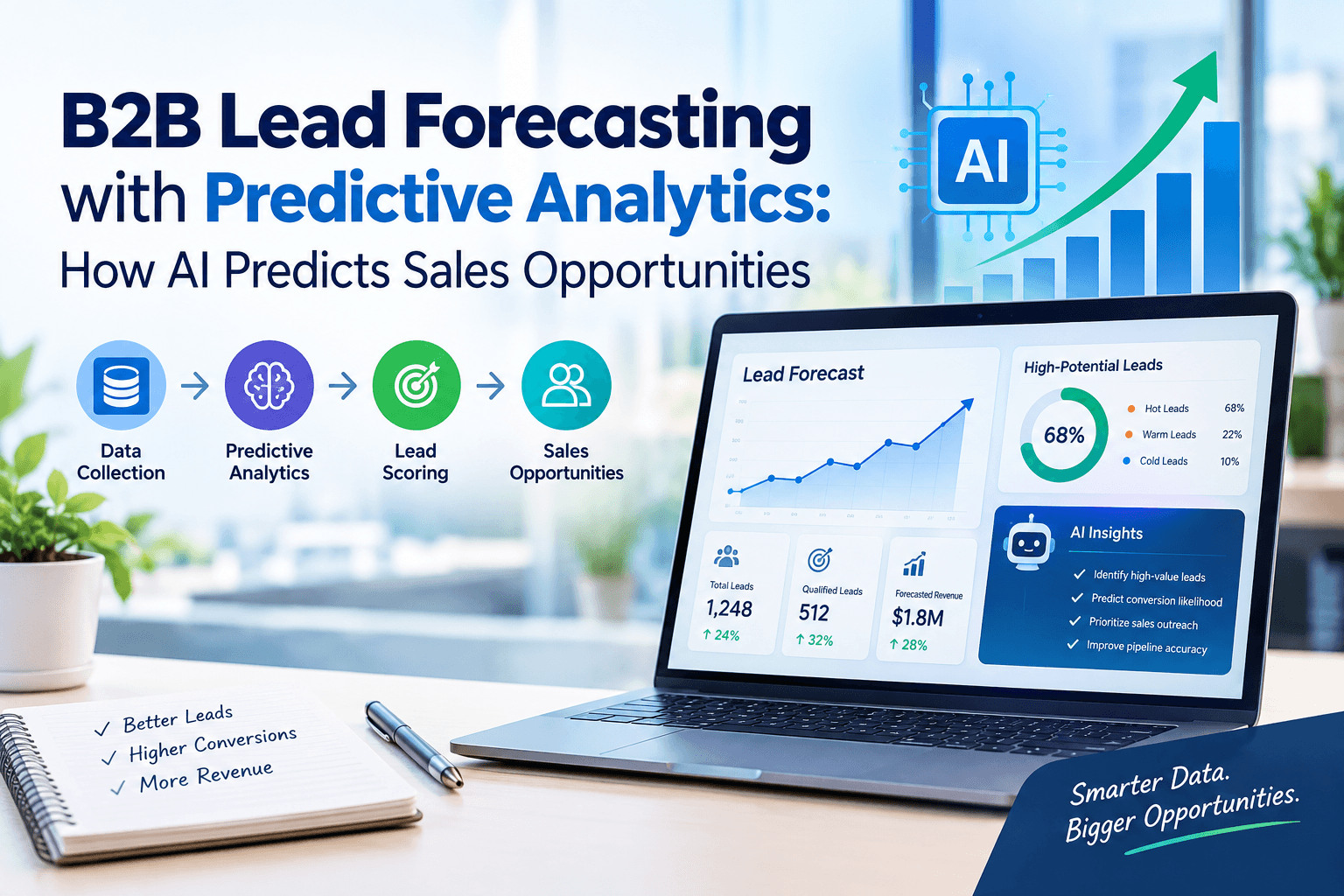
B2B Lead Forecasting with Predictive Analytics: How AI Predicts Sales Opportunities
In modern B2B sales, businesses cannot rely only on intuition to determine which leads are likely to become customers. Sales teams generate large volumes of prospect data from websites, CRM systems, email campaigns, social media, and other channels. The challenge is turning this data into accurate predictions.
This is where predictive analytics for B2B lead forecasting becomes valuable. By analyzing historical data, customer behavior, engagement patterns, and sales activity, predictive analytics can help businesses estimate which leads are more likely to convert and where future sales opportunities may come from.
B2B lead forecasting combines sales data with analytical models to provide a clearer view of future lead performance. Instead of treating every prospect equally, businesses can identify high-potential leads, prioritize sales efforts, and make more informed decisions.
What Is B2B Lead Forecasting?
B2B lead forecasting is the process of predicting the future performance and conversion potential of business-to-business leads.
A traditional sales team may evaluate leads based on basic information such as company size, industry, job title, or previous interactions. Predictive forecasting takes this process further by analyzing multiple data points simultaneously.
These may include:
- Website visits
- Email engagement
- Content downloads
- Previous purchases
- CRM activity
- Sales conversations
- Lead source
- Company characteristics
- Product interest
- Engagement frequency
- Historical conversion patterns
By combining these signals, businesses can estimate which leads have a higher probability of moving through the sales funnel.
What Is Predictive Analytics in B2B Sales?
Predictive analytics uses historical and current data to identify patterns and estimate potential future outcomes.
In B2B sales, predictive analytics can analyze thousands of records much faster than a human sales team. Machine learning algorithms can identify relationships between lead behavior and previous successful conversions.
For example, a company may discover that leads who:
- Visit specific product pages,
- Download a pricing guide,
- Attend a product demonstration, and
- Engage with sales emails
are more likely to become customers.
A predictive analytics system can recognize this pattern and assign higher conversion potential to similar leads.
This makes predictive analytics an important component of modern B2B lead forecasting.
Why B2B Lead Forecasting Matters
Accurate lead forecasting helps sales and marketing teams use their resources more efficiently. Without forecasting, sales representatives may spend too much time on leads that have little chance of converting while overlooking promising opportunities.
Better Lead Prioritization
Predictive models can help sales teams identify leads that demonstrate strong buying signals. Representatives can then prioritize prospects according to their potential rather than simply working through a list in chronological order.
More Efficient Sales Resources
Sales teams have limited time. Predictive lead forecasting can help determine where that time should be spent.
Instead of treating hundreds of leads equally, teams can focus additional attention on prospects showing stronger engagement and buying intent.
Improved Sales Planning
Forecasting provides sales managers with additional information for planning future activities. By examining historical conversion rates and current pipeline activity, managers can develop more informed expectations about upcoming opportunities.
Stronger Marketing and Sales Alignment
Marketing teams generate leads, while sales teams convert qualified opportunities into customers. Predictive analytics can create a shared data-driven framework for determining lead quality.
This can improve communication between both departments and make lead qualification more consistent.
How Predictive Analytics Supports B2B Lead Forecasting
Predictive analytics can support B2B lead forecasting through several important stages.
1. Data Collection
The first step is collecting relevant information from multiple sources.
A business may collect data from its CRM, website analytics, email marketing platform, advertising campaigns, customer records, and sales activities.
The more relevant and reliable the data, the more useful the resulting analysis can be.
2. Data Analysis
After collecting information, predictive systems analyze historical patterns.
The system may examine questions such as:
- Which lead sources generate the most customers?
- What behaviors commonly occur before conversion?
- Which industries have higher conversion rates?
- How long does it typically take a lead to become an opportunity?
- Which engagement signals are associated with successful deals?
These patterns become the foundation for forecasting.
3. Lead Scoring
Predictive analytics can assign scores to leads based on their characteristics and behaviors.
A lead with strong engagement and characteristics similar to previously converted customers may receive a higher predictive score.
This is commonly called predictive lead scoring.
4. Conversion Prediction
The system can estimate the likelihood that a lead will convert.
The prediction is not a guarantee. Instead, it provides a probability or ranking that sales teams can use alongside their own knowledge and qualification processes.
5. Continuous Improvement
Predictive models can be updated as new sales data becomes available.
When more leads convert or fail to convert, the system can use those outcomes to improve future predictions.
This makes B2B lead forecasting an ongoing process rather than a one-time analysis.
Key Data Used for B2B Lead Forecasting
The accuracy of predictive forecasting depends heavily on the quality of the data being analyzed.
Demographic and Firmographic Data
B2B businesses can analyze information such as:
- Company size
- Industry
- Geographic market
- Annual revenue
- Job role
- Department
- Technology usage
This information can help identify businesses that resemble an organization’s existing customers.
Behavioral Data
Behavioral signals can provide insight into a prospect’s level of interest.
Examples include website activity, content downloads, email interactions, webinar attendance, product-page visits, and demo requests.
CRM Data
CRM platforms contain valuable historical information about leads and customers.
Sales teams can analyze previous opportunities, deal stages, sales cycle length, win rates, and customer interactions to identify patterns.
Engagement Data
Frequent and meaningful engagement can sometimes indicate stronger interest. Predictive systems can evaluate engagement alongside other signals rather than relying on a single activity.
Benefits of Predictive B2B Lead Forecasting
Businesses can gain several advantages by incorporating predictive analytics into their lead management strategy.
Higher Sales Productivity
Sales representatives can spend more time on leads that match characteristics associated with successful opportunities.
Faster Lead Qualification
Predictive models can help reduce the time required to evaluate large numbers of prospects.
More Consistent Decision-Making
Instead of relying entirely on individual opinions, sales teams can incorporate historical data into their qualification process.
Better Pipeline Visibility
Forecasting can provide sales managers with additional insight into the potential quality of their pipeline.
Improved Marketing Performance
Businesses can compare lead sources and determine which channels have historically produced stronger opportunities.
Scalable Lead Management
As lead volumes grow, automated predictive models can analyze large datasets without requiring sales representatives to manually evaluate every record.
Challenges of B2B Lead Forecasting
Although predictive analytics can provide significant value, businesses should also understand its limitations.
Poor Data Quality
Incorrect, outdated, duplicated, or incomplete CRM records can reduce forecasting accuracy.
A predictive model cannot produce reliable insights from consistently unreliable data.
Changing Customer Behavior
Historical patterns do not always remain stable. Market conditions, competitors, pricing, economic changes, and customer preferences can influence future buying behavior.
Over-Reliance on Predictions
A predictive score should support sales judgment rather than completely replace it.
A high score does not guarantee a purchase, and a lower-scoring lead may still become a valuable customer.
Integration Complexity
Organizations may store data across multiple systems. Connecting CRM, marketing automation, website analytics, and other platforms can require technical planning.
Best Practices for Improving B2B Lead Forecasting
Businesses can improve their forecasting process by following several practical strategies.
Maintain Clean CRM Data
Regularly remove duplicate records, update outdated information, and establish consistent data-entry standards.
Define Clear Conversion Criteria
Sales and marketing teams should agree on what qualifies as a lead, marketing-qualified lead, sales-qualified lead, opportunity, and customer.
Combine Multiple Signals
Avoid relying on one activity, such as an email click. Combine behavioral, firmographic, historical, and engagement data to create a more comprehensive picture.
Monitor Forecast Accuracy
Compare predictions with actual outcomes. Tracking forecasting performance can help identify areas where the model or sales process needs improvement.
Keep Human Oversight
Sales representatives can provide context that data models may not capture. Predictive analytics should therefore complement human expertise.
B2B Lead Forecasting and AI
Artificial intelligence is making predictive forecasting increasingly sophisticated. AI-powered sales platforms can process large amounts of customer and prospect data, identify patterns, and generate predictions at scale.
AI can also help sales teams detect buying signals, recommend prospects, automate lead scoring, and identify potential changes in customer behavior.
The combination of AI and B2B lead forecasting can help businesses move from reactive sales management toward a more proactive approach.
For example, instead of waiting for a prospect to request a sales call, a sales system may identify a combination of behaviors that historically occurred before a purchase and alert the sales representative.
How to Implement Predictive B2B Lead Forecasting
A practical implementation can follow these steps:
Step 1: Establish a clear objective.
Determine whether the goal is to predict lead conversion, sales-qualified leads, deal creation, revenue, or another measurable outcome.
Step 2: Gather relevant data.
Collect historical lead, customer, marketing, and sales information.
Step 3: Clean the data.
Remove duplicates and correct inaccurate or incomplete records.
Step 4: Identify meaningful signals.
Determine which customer characteristics and behaviors correlate with successful conversions.
Step 5: Build or deploy a predictive model.
Use an appropriate analytics or AI solution to evaluate lead patterns.
Step 6: Integrate predictions into the sales workflow.
Make predictive scores or insights accessible to sales representatives through the CRM or sales platform.
Step 7: Measure results.
Compare forecasts with actual outcomes and continuously improve the process.
Conclusion
Predictive analytics for B2B lead forecasting provides businesses with a data-driven way to understand potential sales opportunities. By analyzing historical customer information, firmographic characteristics, behavioral signals, CRM records, and engagement data, organizations can improve lead prioritization and gain greater visibility into their sales pipeline.
However, predictive forecasting should not be viewed as a replacement for sales expertise. Its greatest value comes from combining data-driven insights with human judgment.
As AI and machine learning continue to develop, B2B lead forecasting is likely to become an increasingly important part of modern sales strategies. Businesses that establish strong data foundations and continuously measure forecasting accuracy can use predictive insights to build more structured, efficient, and scalable sales processes.
You Can Also Read :
[…] Clay AI Helps Increase Sales; AI-Powered Sales Prospecting B2B Lead Forecasting with Predictive Analytics: How AI Predicts Sales Opportunities What is KimiAI? Its Features, Uses and Benefits What Is Pipedrive? 8 Features, Benefits, […]