

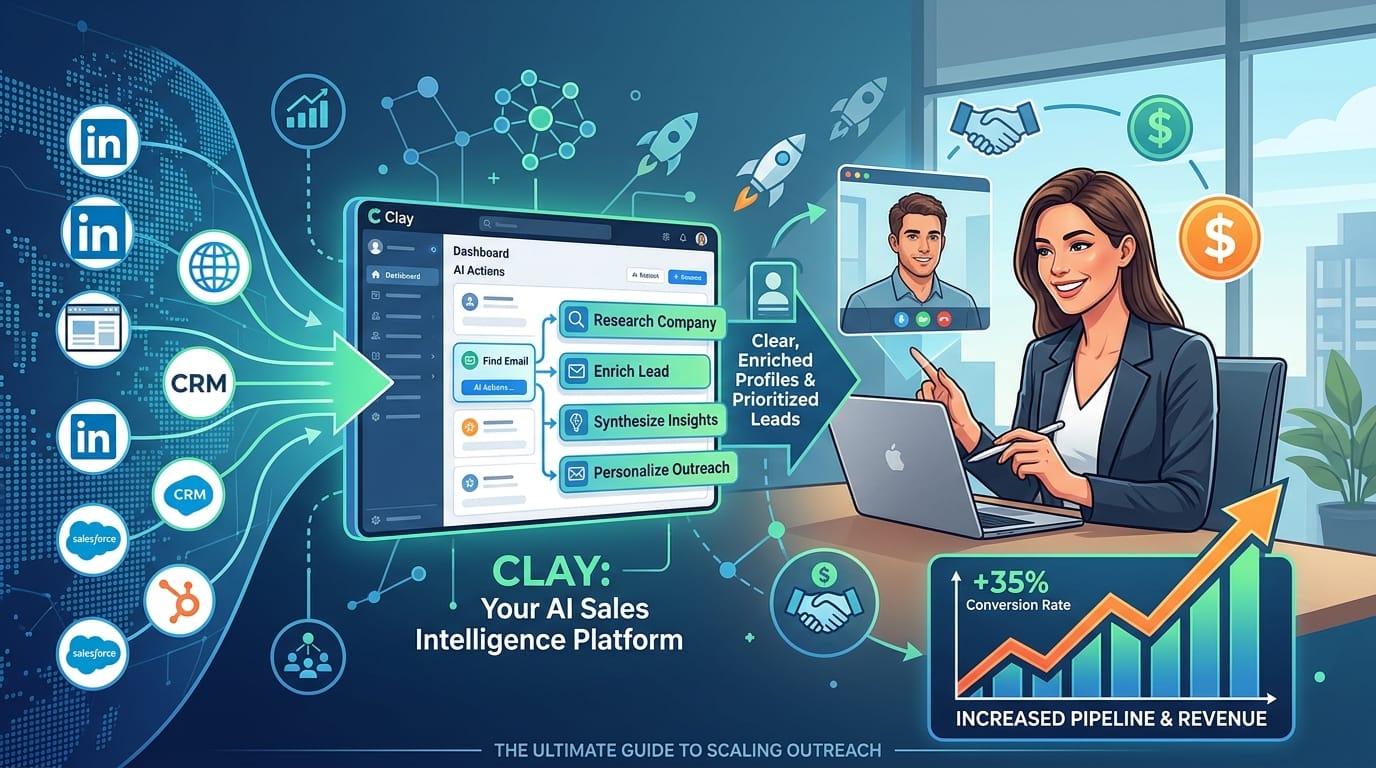
In modern B2B sales, finding the right prospects is only the beginning. Sales teams also need accurate data, personalized messaging, efficient workflows, and timely follow-ups to turn potential customers into paying clients. This is where Clay AI can make a significant difference.
Clay AI is a sales prospecting and data enrichment platform that helps businesses discover potential customers, enrich lead information, research prospects, and create personalized outreach workflows. By combining data from multiple sources with automation and AI-powered research, Clay AI can help sales teams spend less time on manual prospecting and more time engaging with qualified buyers.
For companies looking to improve their sales pipeline, Clay AI provides tools that can support lead generation, account research, personalization, and sales automation.
What Is Clay AI?
Clay AI is a prospecting and sales intelligence platform designed to help businesses identify and research potential customers. Instead of relying on one database, Clay AI can connect sales teams with information from multiple data providers and enrichment sources.
The platform allows users to build prospect lists, enrich contact and company information, research accounts, identify relevant buying signals, and create personalized sales campaigns.
One of the key advantages of Clay AI is its ability to bring different sales data sources into a single workflow. This can reduce the need for sales representatives to manually search multiple platforms when researching prospects.
For B2B companies, this makes Clay AI particularly useful for building targeted prospect lists and creating more relevant sales outreach.
How Clay AI Helps Increase Sales
The main way Clay AI helps increase sales is by improving the prospecting process. A stronger prospecting workflow can help sales representatives identify better-fit leads, understand their needs, personalize communication, and move prospects through the sales funnel more efficiently.
Here are some of the major ways Clay AI can contribute to sales growth.
- Clay AI Helps Find Better Sales Prospects
Finding the right prospects is essential for successful B2B sales. Sales representatives can waste significant time contacting companies that do not match their ideal customer profile.
Clay AI helps businesses create targeted prospect lists based on specific characteristics such as company size, industry, location, job title, technology usage, and other business criteria.
Instead of approaching a broad audience, sales teams can focus their efforts on accounts that are more closely aligned with their products or services.
Better targeting can improve the quality of sales conversations and reduce wasted outreach.
- Clay AI Improves Lead Data Enrichment
Incomplete or outdated lead information can make sales prospecting difficult. A salesperson may have a company name and email address but lack information about the company’s size, technology stack, business model, or relevant decision-makers.
Clay AI helps enrich prospect and company records by gathering additional information from different data sources.
For example, sales teams can use enriched data to understand:
- Company information
- Contact details
- Job roles
- Company size
- Industry
- Technology usage
- Business characteristics
- Relevant online information
Having more complete prospect information gives sales representatives greater context before starting a conversation.
- Clay AI Supports Personalized Sales Outreach
Personalization has become an important part of modern B2B sales. Generic emails are often easier for prospects to ignore because they do not address the recipient’s specific situation.
Clay AI can help sales teams research prospects and use that information to create more personalized messaging.
For example, instead of sending the same message to every prospect, a sales team can customize outreach based on a company’s recent activity, industry, technology, job role, or business needs.
This allows sales representatives to create messages that feel more relevant to individual prospects.
The goal is not simply to add a prospect’s first name to an email. Effective personalization uses meaningful information to explain why the conversation could be relevant to that particular prospect.
- Clay AI Helps Identify Sales Opportunities
Sales opportunities are not always obvious from basic contact information. A company may become a strong prospect because of a change in its business, technology, hiring activity, leadership, or other publicly available signals.
Clay AI can support research workflows that help sales teams discover useful information about target accounts.
For example, a company researching a prospect could look for signals related to:
- Business expansion
- New employees
- Technology changes
- Leadership changes
- Product launches
- Industry developments
- Company growth
These insights can help sales representatives determine when and how to approach an account.
- Clay AI Makes Account Research More Efficient
Effective B2B sales often require research before contacting a prospect. Sales representatives need to understand the company, its market, and the people involved in purchasing decisions.
Without the right tools, this research can require multiple websites and several manual searches.
Clay AI can bring different research and enrichment activities into a structured workflow. This allows sales teams to gather relevant information more efficiently.
Better account research can help representatives enter conversations with greater context and develop messaging that is connected to the prospect’s business situation.
- Clay AI Helps Scale Outbound Sales
Outbound sales teams often face a difficult balance: they want to contact enough prospects to generate opportunities while maintaining high-quality personalization.
Sending hundreds of identical messages may increase activity but does not necessarily create meaningful conversations.
Clay can help sales teams scale prospecting while incorporating research and personalization into their workflows.
This makes it possible to build larger prospecting campaigns without relying entirely on manual research for every account.
For companies with ambitious outbound sales goals, this combination of automation and personalization can make sales operations more scalable.
- Clay Can Improve Sales Team Productivity
Sales productivity is not only about contacting more prospects. It is also about reducing time spent on tasks that do not directly contribute to revenue generation.
By automating prospect research, enrichment, and other repetitive workflows, Clay AI can help sales professionals focus their time on higher-value activities.
A more productive sales process can include:
- Identifying ideal customer profiles
- Building targeted account lists
- Enriching prospect data
- Researching potential customers
- Creating personalized messaging
- Launching outreach
- Following up with qualified prospects
- Moving interested prospects into the sales pipeline
This structured approach can make prospecting more consistent and efficient.
Clay for B2B Sales Teams
Clay can be especially useful for B2B companies because B2B sales frequently involve detailed targeting and multiple decision-makers.
Businesses selling software, professional services, consulting, marketing services, technology products, and other B2B solutions can use Clay AI to support account-based prospecting and lead-generation workflows.
For example, a sales team could define an ideal customer profile, identify companies that match the criteria, find relevant decision-makers, enrich their information, research each account, and create personalized outreach.
This creates a more structured process from lead discovery to sales engagement.
Clay and AI-Powered Sales Prospecting
One of the reasons Clay has gained attention among modern sales teams is its focus on AI-assisted research and workflow automation.
AI can help sales teams process large amounts of information and turn raw prospect data into useful insights.
Instead of manually researching every company, teams can create workflows that collect and organize relevant information at scale.
However, AI should support rather than completely replace human sales judgment. Sales representatives still need to evaluate whether a prospect is genuinely relevant and determine the best way to build a relationship.
How to Use Clay Effectively for Sales
Getting value from Clay requires more than simply creating a large prospect list. Businesses should build a clear sales process around the platform.
Define Your Ideal Customer Profile
Start by identifying the characteristics of companies most likely to benefit from your product or service.
Consider industry, company size, geography, technology, business model, and decision-maker roles.
Build Targeted Prospect Lists
Use your criteria to identify accounts and contacts that fit your ideal customer profile.
The objective should be quality and relevance rather than simply maximizing the number of leads.
Enrich Prospect Data
Add useful information to prospect records so sales representatives have sufficient context before outreach.
Create Relevant Personalization
Use prospect and company information to develop messages that address a specific business situation or potential need.
Automate Repetitive Workflows
Automate research and enrichment tasks where possible while maintaining human oversight over important sales decisions.
Measure Results
Track metrics such as qualified leads, response rates, meetings booked, opportunities created, and revenue generated.
These measurements can help determine which Clay AI workflows are producing meaningful sales outcomes.
Benefits of Clay for Sales Teams
The potential benefits of using Clay in a sales process include:
- More targeted prospecting
- Better lead data
- Faster account research
- More personalized outreach
- Reduced manual work
- Scalable outbound campaigns
- Improved sales productivity
- More structured prospecting workflows
- Better use of sales intelligence
The exact results will depend on factors such as data quality, targeting strategy, messaging, offer quality, sales execution, and the overall sales process.
You Can Also Read :
B2B Lead Forecasting with Predictive Analytics: How AI Predicts Sales
Visit Clay Official Website :