

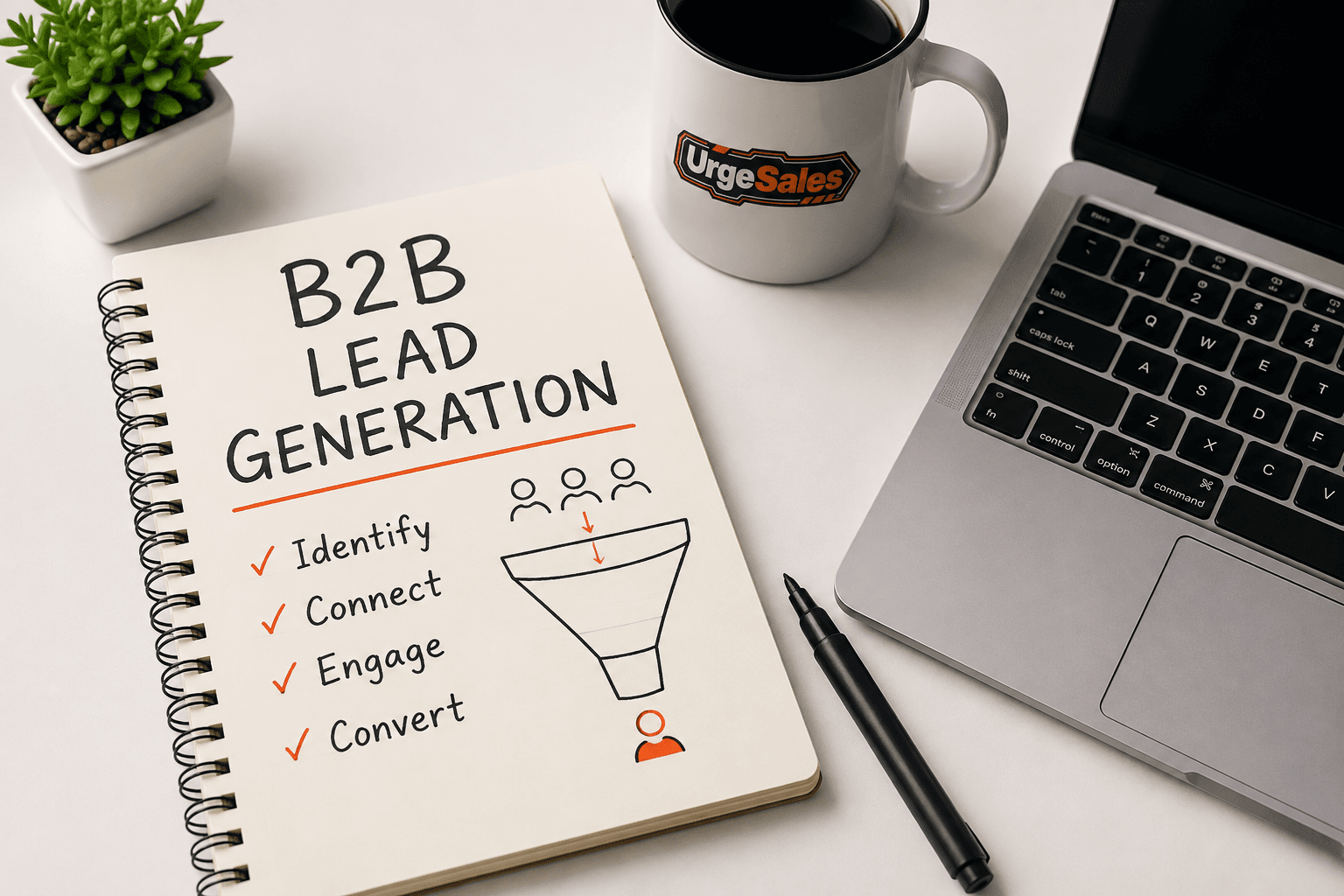
Most sales teams don’t struggle with closing deals. They struggle with a pipeline problem — there aren’t enough meaningful conversations happening at the top of the funnel.
B2B lead generation is the process designed to fix this. But the definition shifts depending on who you ask. A marketer sees it as gathering contact information through content. An SDR defines it as booking meetings. A founder considers it anyone who could plausibly become a customer. Each view has some truth to it, and that’s exactly why lead generation strategy so often breaks down across departments — everyone is optimizing for a different definition of the same word.
This guide breaks down what B2B lead generation actually means, how it differs from demand generation and prospecting, which methods work in 2026, the benchmarks worth knowing, and how to build a repeatable system instead of a one-off campaign.
In this guide
- What B2B lead generation really means
- Lead generation vs. demand generation vs. prospecting
- MQLs vs. SQLs
- Methods that work in 2026
- Benchmarks worth knowing
- Building a system, not a campaign
- Common mistakes
- FAQ
What B2B lead generation really means
B2B lead generation is the process of identifying and attracting companies — not individual consumers — that have a valid reason to buy your product, and converting that interest into a documented contact who can enter your sales pipeline.
The key phrase is “valid reason to buy.” A lead isn’t just a name and an email address — it’s a person at a company whose situation suggests they may have a problem you can solve. Without that signal, you’re not generating leads. You’re collecting data.
Lead generation vs. demand generation vs. prospecting
These three terms get used interchangeably, which causes real strategic confusion.
Demand generation is the broader effort to make your target audience aware of a problem and your solution. It creates the environment in which lead generation can happen. Think of demand generation as warming the water and lead generation as catching the fish — you need both, but they’re not the same job, and they’re usually not the same person’s job.
Prospecting is the activity of sales reps finding and reaching out to specific individuals. It’s a subset of lead generation — the outbound half. Lead generation is the broader category, because it also includes inbound methods where leads come to you without a rep reaching out first.
If your marketing and sales teams are arguing about whose numbers are “real,” it’s often because one side is counting demand generation activity (content views, ad clicks) as leads, while the other is only counting qualified prospecting outcomes. Aligning on these three definitions in writing solves more friction than most process overhauls.
The two types of B2B leads
| Marketing Qualified Lead (MQL) | Sales Qualified Lead (SQL) | |
|---|---|---|
| Signal | Downloaded a guide, attended a webinar, visited pricing page repeatedly | A rep has spoken to them directly |
| Confirmed by | Marketing, based on behavior | Sales, based on conversation |
| Confirms | Interest | Real problem + budget + authority |
| Status | A lead, not a guaranteed sale | An opportunity in the pipeline |
| Next step | Sales follow-up / qualification call | Move into active deal stages |
An MQL shows interest. An SQL is an MQL that a rep has personally confirmed has a real problem, the budget to fix it, and the authority to decide. The speed and accuracy of MQL-to-SQL conversion is one of the clearest indicators of how well marketing and sales are actually aligned — not just how much content is getting produced.
If your team doesn’t have written, agreed-upon criteria for what counts as an MQL and what counts as an SQL, that’s the first process gap to close before optimizing anything downstream. Teams with explicit, documented handoff criteria consistently report fewer dropped or double-worked leads than teams relying on informal, rep-by-rep judgment calls — because everyone is qualifying against the same bar instead of their own.
B2B lead generation methods that work in 2026
Outbound: you go to them
Cold email remains one of the most common outbound channels. What’s changed is the mechanics: deliverability now depends on technical setup — SPF, DKIM, and DMARC records properly configured, plus a warmed-up sending domain (tools like Mailreach or Warmup Inbox are commonly used to test and build sender reputation before a campaign goes live). Personalization has to go beyond a first-name merge field; a line referencing something specific to the recipient’s role or recent activity outperforms generic templates. Shorter 3–4 email sequences are generally outperforming the long, 8-touch automated sequences that were standard a few years ago.
Example of a specific, low-effort personalization line that outperforms generic openers:
“Saw [Company] just posted for a second SDR — usually a sign the current team’s underwater on outbound. Is that the gap, or is it more about coverage across time zones?”
This works because it references something verifiable and asks a real question, rather than opening with a pitch.
AI tools are increasingly part of this outbound stack too — see our breakdown of AI tools for sales
LinkedIn outreach works best as a complement to email, not a replacement — pairing a connection request or message with an email touch tends to lift response rates. The platform is noisier than it was even a couple of years ago, so generic connection requests are largely ignored. Voice notes, short personalized video messages, and referencing something specific the prospect has posted are what currently stand out.
Cold calling isn’t gone, but its effectiveness depends heavily on deal size. For enterprise deals with high annual contract value, a call is often the fastest way to qualify or disqualify a lead. For SMB SaaS with a large volume of target accounts, straight cold calling rarelyjustifies the time investment unless it’s one touch within a broader multichannel sequence.
Inbound: they come to you
Content marketing and SEO produce leads over time. A well-researched article ranking for a commercial-intent term — “best CRM for small teams,” “how to structure a sales team” — generates consistent qualified traffic long after the cost of creating it. This is a compounding channel: slow to build, but it keeps producing once it’s running, unlike a paid campaign that stops the moment spend stops.
Lead magnets — free tools, templates, checklists, calculators — convert a higher percentage of visitors than standard blog content because they offer an immediate, tangible benefit. Concrete examples that work well in this space: a cold email subject line swipe file, a sales compensation calculator, a discovery call question bank. A simple discovery-call question bank might include:
- “What’s driving the timing on this — why now, not six months ago?”
- “Who else is involved in this decision, and what does each person need to see?”
- “What happens if this problem stays unsolved for another quarter?”
Webinars and virtual events remain high-quality inbound sources for B2B. A registrant spending 30–60 minutes watching indicates meaningfully more interest than a page view. The real challenge is filling seats, which is why webinars work best as a mid-funnel tactic aimed at an audience you’ve already built through content — not as a cold acquisition channel on their own.
Benchmarks worth knowing
Every B2B org’s numbers vary by industry, deal size, and list quality, so treat these as reference ranges to sanity-check your own metrics against, not universal targets:
- Cold email reply rates: a well-targeted, personalized B2B cold email sequence commonly lands somewhere in the low single digits to around 8–10% reply rate; anything meaningfully below that usually points to a targeting or deliverability problem rather than a messaging problem.
- MQL-to-SQL conversion: varies widely by how strict MQL criteria are, but a large unexplained drop-off (most MQLs never becoming SQLs) is usually a sign the MQL bar is set too low.
- Multitouch requirement: most B2B outbound responses come after multiple touches across channels (email + LinkedIn + occasionally a call), not from a single message — sequences built around one channel and one attempt tend to underperform.
If you have internal data, replace these ranges with your own — a guide like this becomes far more valuable, and far more linkable, once it’s citing your team’s real numbers.
What makes a lead generation system — not just a campaign
A campaign is something you run. A system is something that runs. This distinction matters because many B2B companies run a lead generation campaign, get a burst of activity, and then wonder why the pipeline dries up a few months later.
A real lead generation system has four components running at the same time:
1. A clearly defined ideal customer profile (ICP).
A written description of the specific company type, size, industry, and situation most likely to buy and succeed with your product. Without this, every other component is working against a moving target — messaging can’t be sharp, and qualification criteria can’t be consistent, because “who we’re selling to” keeps shifting from deal to deal.
2. A consistent outreach cadence.
The specific sequence of touches — which channel, in what order, how many days apart — that your team runs on every qualified account, not just the ones a rep happens to feel like prioritizing. Consistency here is what turns lead generation into a predictable input rather than a lucky quarter.
3. Messaging tied to a specific problem, not a generic pitch.
Cadence without sharp messaging just means more people ignoring you faster. The messaging component maps each outreach touch to a specific, verifiable trigger or pain point relevant to that ICP segment — not one generic pitch reused across every account.
4. Measurement that feeds back into the other three.
Tracking reply rates, MQL-to-SQL conversion, and time-to-response by channel and segment — then actually using that data to adjust the ICP, cadence, or messaging. Without this feedback loop, a company can run the same underperforming approach for months without knowing which of the first three components is the actual problem.
These four components reinforce each other: a sharp ICP makes messaging easier to write; consistent cadence makes measurement meaningful (you’re comparing apples to apples); and measurement is what tells you whether to adjust the ICP itself. Most “our lead gen doesn’t work” situations trace back to only one or two of these four actually being in place.
Common mistakes that undercut lead generation
- Treating a single campaign as a strategy. A month-long outbound push with no cadence maintained afterward produces a temporary spike and nothing durable.
- Generic LinkedIn connection requests with no context. These are now largely ignored; a request with zero personalization performs close to random chance.
- Long, fully automated 8+ touch sequences. These were common a few years ago and increasingly underperform shorter, more targeted 3–4 touch sequences with real personalization.
- No written MQL/SQL definitions. This alone causes more sales-marketing friction and lost pipeline visibility than almost any other single gap.
- Skipping technical email setup. Sending cold outbound from a domain without SPF/DKIM/DMARC configured and a warm-up period tanks deliverability before the message content even matters.
- Measuring activity instead of outcomes. Emails sent and calls made are inputs, not evidence the system is working — reply rate, MQL-to-SQL conversion, and pipeline generated are the numbers that actually matter.
FAQ
What’s the difference between a lead and a prospect?
A prospect is someone a rep has identified as a potential fit and is actively targeting through outreach. A lead has already shown some form of interest or engagement — through a form fill, content download, or reply — that a prospect hasn’t necessarily shown yet.
How many leads should an SDR generate per month?
This varies heavily by industry, deal size, and whether the role is outbound-focused or inbound-response-focused, so there’s no single universal number. It’s more useful to set targets based on your own historical conversion data — working backward from the pipeline value your team needs.
Is cold email still effective in 2026?
Yes, but the bar has risen. Generic, unpersonalized blasts perform poorly and increasingly hurt sender reputation. Targeted, technically well-configured, personalized outreach still generates real conversations.
What’s the difference between lead generation and demand generation?
Demand generation builds awareness of a problem and your solution at a broad level. Lead generation converts that awareness into a documented, contactable person who can enter the sales pipeline. Demand generation creates the conditions; lead generation captures the result.
Should marketing or sales own lead generation?
In most effective B2B organizations, it’s shared — marketing typically owns top-of-funnel demand and inbound lead capture, while sales owns outbound prospecting and qualification. The system works best when both sides agree on shared MQL/SQL definitions rather than operating with separate, uncoordinated goals.
UrgeSales AI sales agents
Want a steady flow of qualified B2B leads without manual prospecting?
UrgeSales AI agents find your ideal prospects, research each account, write personalized emails, follow up automatically and book meetings on your calendar.
Related Guides on UrgeSales
- B2B Lead Generation Strategies for Small Business: 7 Proven Tactics
- How to Build a Cold Email Sequence That Gets 20%+ Reply Rates
- How Many Emails Per Day Per Domain Cold Outreach? (Proven Guide)
- B2B Lead Forecasting with Predictive Analytics: How AI Predicts Sales Opportunities
[…] SpaceX Q2 2026 Earnings Report (SPCX): Results, Starlink Growth, and What Every Investor Needs to Know How Artificial intelligence helps in boosting sales. AI tools for sales What Is B2B Lead Generation? A Practical Guide for Sales Teams […]
[…] How to Build a Cold Email Sequence That Gets 20%+ Reply Rates SpaceX Q2 2026 Earnings Report (SPCX): Results, Starlink Growth, and What Every Investor Needs to Know How Artificial intelligence helps in boosting sales. AI tools for sales What Is B2B Lead Generation? A Practical Guide for Sales Teams […]
[…] Apollo.ai vs Seamless.ai vs Lusha: Comprehensive Head-to-Head Comparison How to Build a Cold Email Sequence That Gets 20%+ Reply Rates SpaceX Q2 2026 Earnings Report (SPCX): Results, Starlink Growth, and What Every Investor Needs to Know How Artificial intelligence helps in boosting sales. AI tools for sales What Is B2B Lead Generation? A Practical Guide for Sales Teams […]
[…] for small business websites, targeting high-intent commercial keywords and establishing a clear content hub architecture consistently delivers the highest conversion […]
[…] B2B Lead Generation Strategies for Small Business […]