

Table of Contents
- 1. The IPO and What’s Happened Since
- 2. What Wall Street Expected
- 3. The Three Business Segments
- 4. Analyst Price Targets
- 5. The August 6 Lockup Expiration
- 6. Short Sellers and Volatility
- 7. What This Means for the Broader Market
- 8. How to Access SPCX Stock
- 9. Should You Buy It?
- 10. What to Watch Next
- 11. FAQ
1. The IPO and What’s Happened Since
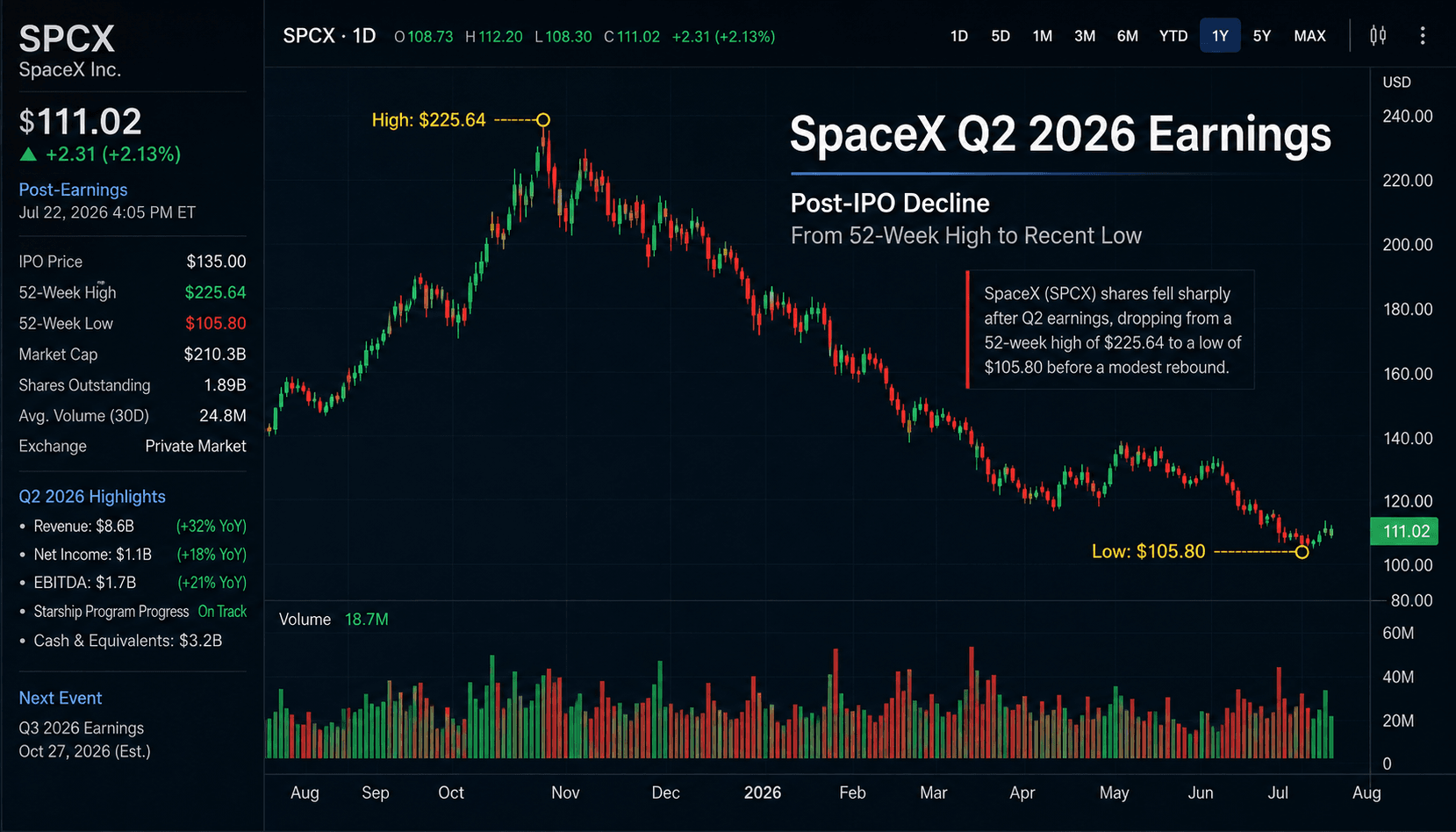
The anticipation around the SpaceX Q2 2026 earnings report highlights a pivotal moment for public market investors. For more than two decades, SpaceX operated entirely outside public markets, answering only to private investors and its own roadmap. That changed on June 11, 2026, when SpaceX (Nasdaq: SPCX) priced its IPO at $135 per share, raising $75 billion — the largest IPO in market history.
Within days of going public, the stock climbed to an intraday peak of $225.64. By early August, SPCX had fallen more than 50% from that peak, briefly touching a record low near $105.80 before partially recovering. Three forces have driven that pullback:
- Valuation pressure: Even after the decline, SPCX traded at roughly 36–49x projected 2026 revenue heading into earnings — a multiple that leaves little room for disappointment.
- The looming lockup expiration: Covered in detail in Section 5.
- Broader skepticism about AI infrastructure spending: The same debate playing out across mega-cap tech stocks like Oracle, Alphabet, and Meta.
For anyone researching how IPO investing works, this is a live lesson: a record-breaking debut and a strong long-term business are not the same as near-term price stability.
2. What Wall Street Expected
| Metric | Q1 2026 (Reported) | Q2 2026 (Estimate) | Full-Year 2026 (Estimate) |
|---|---|---|---|
| Revenue | $4.7B | $6.8–$6.9B | ~$39B |
| Adjusted EPS | — | –$0.23 to –$0.25 | — |
| Adjusted EBITDA | — | ~$2.0–$2.1B | ~$17.3B |
| Net loss | $4.28B | Est. loss | Est. loss |
Consensus per Bloomberg/FactSet as reported ahead of the release.
For the 2025 fiscal year, SpaceX closed out with a net loss totaling $4.9 billion. This is a company asking public investors to trust that scale and profitability are still ahead of it — not one that’s already proven it.
3. The Three Business Segments
Starlink (Connectivity): The only profitable segment. Generated $11.4B revenue in 2025 (61% of total) and $4.42B operating income. Subscribers grew from ~5 million to over 12 million between mid-2025 and June 2026. A new $10/month equipment fee suggests management is leaning on this segment to fund the rest of the business.
Launch Services: Despite large government and NASA contracts, this segment has reportedly operated at a loss. Reusable rockets do bring per-launch costs down, but running Falcon 9, Falcon Heavy, and Starship development in parallel demands an enormous amount of capital.
AI / SpaceX AI (post-xAI merger): SpaceX merged with xAI in February 2026 around a shared AI-infrastructure vision. The company has a reported Google Cloud compute deal worth roughly $920 million per month. This segment remains in its investment phase, with no demonstrated profitability yet.
4. Analyst Price Targets
| Stance | Approx. Target | Implied Move* |
|---|---|---|
| Bearish | ~$63 | –47% |
| Consensus (~20+ analysts) | ~$223 | +89% |
| Bullish | $236+ | +100%+ |
*Relative to prices in the $115–$120 range in early August 2026. These are analyst projections, not confirmed results. Current live pricing: Nasdaq SPCX quote, Morningstar SPCX analysis.
A $63-to-$236+ spread reflects genuine, unresolved disagreement among professional analysts about whether SpaceX’s AI and Starship bets pay off — not a data error. Treat any single confident price target with appropriate skepticism.
5. The August 6 Lockup Expiration
This may matter more to the stock’s near-term price than the earnings numbers themselves. When SpaceX went public, early investors and employees were barred from selling shares for a set period. That restriction partially lifts on August 6.
| Metric | Figure |
|---|---|
| Shares currently in public float | ~639 million |
| Additional shares eligible August 6 | ~911.5 million |
The pool of sellable shares could more than double. Not all of it will be sold — some early investors have publicly said they plan to hold — but even partial selling creates mechanical downward pressure independent of how good Q2 numbers are. Watch trading volume in the days following August 6 for the real signal.
6. Short Sellers and Volatility
Short interest has been substantial since the IPO, built on concerns about cash burn from the AI buildout, lockup-driven supply, and Starship’s historically slippery timelines. That same short interest creates squeeze risk: a strong earnings beat could trigger rapid short covering and an outsized upward move. Expect SPCX to stay volatile in both directions around this catalyst.
7. What This Means for the Broader Market
AI capital spending scrutiny extends well beyond SpaceX — Oracle, Alphabet, and Meta face the same investor questions about whether massive AI infrastructure spend will pay off.
Lockup expirations are a real, recurring risk, not a footnote — check a company’s lockup schedule before buying into any recent IPO.
Diversification matters — a stock down 50% in under two months from its peak is a live argument for not concentrating capital in one high-volatility name.
8. How to Access SPCX Stock
SPCX trades on the Nasdaq and is available through any major online brokerage. Before opening a position in a volatile, newly public stock like this, compare brokers on commission structure, extended-hours trading access, and available research tools. For portfolio sizing, a licensed financial advisor can help weigh this against your existing exposure.
9. Should You Buy It?
Case for: proven Starlink profitability, strong subscriber growth, a real (if early) AI revenue contract, and consensus targets implying meaningful upside.
Case for caution: consolidated losses, a launch segment that isn’t yet profitable, an unproven AI bet with heavy and rising capex/debt projections, and lockup-driven supply pressure independent of fundamentals.
This isn’t a call this article can make for you — the analyst spread above tells you how unresolved the debate is among people with full access to the numbers. Evaluate segment-level performance rather than a single headline figure, and size any position against your own risk tolerance.
This section is educational, not financial advice.
10. What to Watch Next
- August 6 lockup: trading volume and price action in the days after.
- Full-year guidance: whether the ~$39B revenue / ~$17.3B EBITDA consensus is reaffirmed, raised, or cut.
- Additional AI contracts beyond the Google Cloud deal.
- Starship’s next test flight, targeted for late August/September, including the planned tower-catch attempt.
- Starlink subscriber trajectory past the 12 million mark reported in June.
11. FAQ
What is a lockup period and why does it matter? A contractual restriction, typically 90–180 days post-IPO, preventing insiders from selling shares. When it lifts, a wave of new sellable supply can pressure the stock even if the business is performing well. SpaceX’s exact terms are in its SEC filing.
Is Starlink profitable? Yes — SpaceX’s only profitable segment as of 2025, with $11.4B revenue and $4.42B operating income.
How much has SPCX fallen since IPO? More than 50% from its $225.64 intraday high as of early August 2026.
What is the SpaceX–xAI merger? A February 2026 merger combining SpaceX with Elon Musk’s AI company around a shared AI-compute infrastructure strategy, including a reported Google Cloud deal worth roughly $920 million per month.
Sources
- SpaceX Investor Relations — primary source for financials
- SEC EDGAR — SpaceX registration filing — primary source for lockup terms
- Nasdaq — SPCX quote
- Morningstar — SPCX analysis
- CBS News — SpaceX’s first earnings report preview
This piece is meant to inform, not to advise — nothing here should be read as a recommendation to buy or sell any security. The figures reflect analyst projections at the time of writing and may change once SpaceX’s official results are out. As with any investment, there’s a chance of losing some or all of the principal you put in.
AI capital spending scrutiny extends well beyond SpaceX — major tech firms face continuous questions about ROI on infrastructure. To see how companies are actually turning technology spend into revenue, read our breakdown on how artificial intelligence helps in boosting sales.
Evaluating newly public growth companies requires looking beyond headline hype. For strategies on analyzing business growth and commercial opportunities, explore our B2B lead generation guide.